Professional mold removal means removing contaminated material under containment, cleaning what can be saved, drying the structure, and correcting the moisture source that caused it. In the Fraser Valley, small contained jobs typically run $500 to $1,500, single rooms $1,500 to $4,000, attics $1,500 to $6,000 and crawlspaces $2,000 to $8,000, quoted firm in writing first.
What Does Professional Mold Remediation Involve?
Professional mold removal means physically removing contaminated material under containment, cleaning what can be saved, drying the structure, and correcting the moisture problem that grew the mold in the first place. If a contractor's plan is "spray it and paint it," you are paying for the problem to be hidden. Mold digests the material it grows on; killing surface growth without removing colonized material or fixing the moisture leaves both the food and the water in place, and the growth returns, usually behind fresh paint where you cannot watch it.
In the Fraser Valley this matters more than in drier regions, because our long wet season guarantees the moisture side of the equation from October to March. A remediation that ignores ventilation, insulation or drainage in this climate has a built-in expiry date.
How Does the Remediation Process Work, Step by Step?
Every job runs through the same seven steps, and the order matters as much as the work: scope, containment, removal, cleaning, drying, moisture correction, verification.
- Scope and firm quote. From an inspection, we define exactly which materials come out, what gets cleaned in place, and what moisture correction is included. You approve a written price before anything is touched.
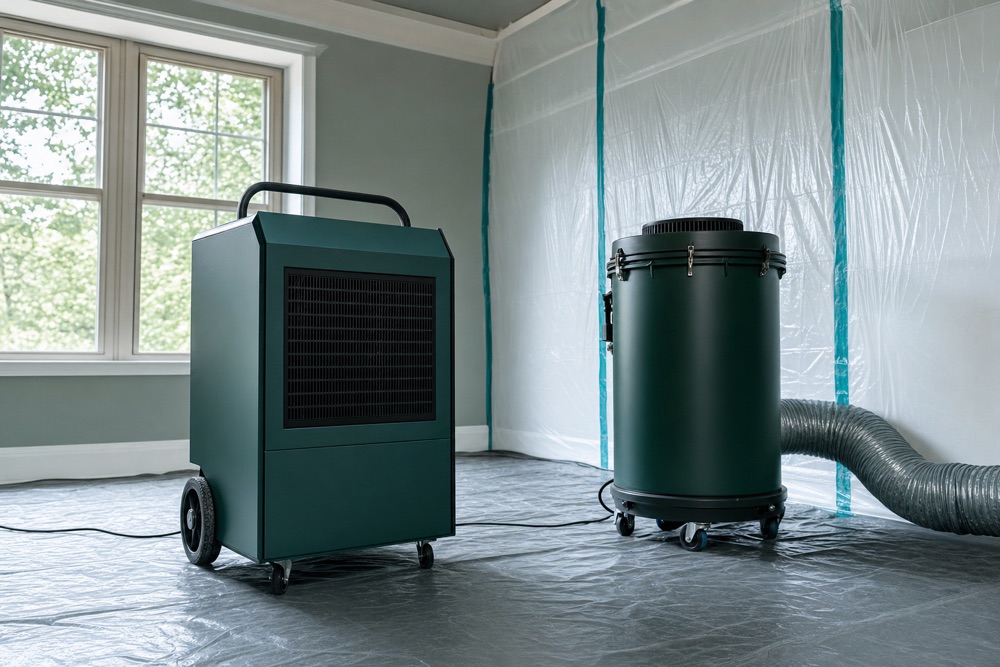
- Containment. The work area is sealed with poly sheeting and put under negative pressure using HEPA-filtered air machines. Vents are sealed so spores cannot ride the ductwork to the rest of the house.
- Removal. Colonized drywall, insulation, carpet and other porous materials are cut out, bagged, sealed and removed. Workers use proper respiratory and skin protection throughout.
- Cleaning of structural surfaces. Framing and sheathing that can be saved are HEPA-vacuumed and cleaned, and stubborn surface growth is abraded off (sanding or media blasting on larger jobs) rather than painted over.
- Drying. Dehumidifiers and air movers bring wood and concrete back to safe moisture content, confirmed by meter readings, not by guesswork or by "it looks dry."
- Moisture correction. The fan gets ducted outside, the grade or gutter problem gets addressed, the vapour barrier gets sealed, the ventilation gets improved. This step is the difference between removal and remediation.
- Verification. Final HEPA vacuuming and wipe-down, visual verification, and optional third-party clearance testing before rebuild. We are happy to have our work independently tested.
How Much Does Mold Removal Cost in the Fraser Valley?
Most residential jobs land between $500 and $8,000, with the spread driven by the affected area, access, how much porous material must be removed and how much moisture repair is needed.
| Job type | Typical range | What usually drives the number |
|---|---|---|
| Small contained cleanup (one wall, vanity, closet) | $500 to $1,500 | Containment setup, removal of a limited area of drywall, HEPA cleaning |
| Single room, including finished basements | $1,500 to $4,000 | Volume of drywall, carpet and insulation removed, plus drying time |
| Attic sheathing plus venting corrections | $1,500 to $6,000 | Area of staining, roof pitch and access, insulation replacement, duct rerouting |
| Crawlspace, including moisture control | $2,000 to $8,000 | Footprint, working height, contaminated insulation, vapour barrier and drainage work |
| Post-flood or whole-level remediation | Quoted per project | Water category, how long materials stayed wet, structural drying duration |
Indicative Fraser Valley ranges as of August 2026, not a quote. Firm written pricing always comes before work starts. Our guide to mold removal costs across BC breaks the numbers down further.
Should You DIY It or Hire a Professional?
Not every patch of mold needs a crew in coveralls. Health Canada's rule of thumb: a small area (under about one square metre) on a cleanable surface can be handled by a healthy homeowner with water, detergent, gloves, goggles and a properly fitted mask. Good candidates are bathroom ceilings, window frames, and tile grout, where growth sits on the surface and the moisture cause is obvious.
Call a professional instead when any of these apply:
- The total area is larger than about one square metre, or there are several patches
- Mold is inside a wall, ceiling, attic or crawlspace rather than on an open surface
- It returns after you clean it (the moisture source is winning)
- The growth follows a flood, a slow leak or a sewer backup
- Anyone in the home has asthma, allergies, or a weakened immune system
- The material is porous: drywall, insulation, carpet, particleboard
The reason for the boundary is spread. Scrubbing a large colony without containment aerosolizes spores and can seed the rest of the house, turning a one-room problem into a whole-home one. The money saved on a weekend of scrubbing is spent several times over if that happens.
Where Do Fraser Valley Homes Grow Mold Most Often?
Five places account for the large majority of the mold we remove in this region, and four of them are hidden from daily view.
- Attics: black staining across roof sheathing, usually fed by bathroom fans venting into the attic space. The region's most common major mold problem.
- Crawlspaces: joist and subfloor growth over damp ground, common in older Mission, Chilliwack and rural properties.
- Basements and bathrooms: condensation and leak-driven growth in the two highest-humidity zones of the house.
- After floods: wall cavities and flooring that were wet longer than 48 hours, whether from a burst pipe or overland water.
- Renovation discoveries: mold found when a contractor opens a wall. We can mobilize quickly so your renovation schedule survives.
What Should a Proper Mold Removal Quote Say?
It should name every material that comes out, every surface that gets cleaned, the drying and verification steps, and the moisture repair, each priced separately so you can compare bids line by line rather than on a single number.
We won't sell you fogging as a standalone fix, quote "mold removal" that leaves wet materials in the wall, or invent scary species talk to inflate a job. Remediation is construction work with dust control, done in a specific order for specific reasons. The quote you get will say exactly what comes out, what gets cleaned, what gets fixed and what it costs, so you can compare it line-by-line against anyone else's.
Frequently Asked Questions
How much does professional mold removal cost?
In the Fraser Valley, small contained jobs like a bathroom ceiling or a window wall typically run $500 to $1,500. Mid-size jobs involving drywall removal in one or two rooms usually land between $1,500 and $4,000. Attics, crawlspaces and post-flood projects range higher depending on area and the moisture repairs needed. Every job is quoted firm and in writing before work starts.
Can I just spray the mold with bleach?
Bleach is not a fix for most household mold. On porous materials like drywall and wood, the water in bleach soaks in while the chlorine stays near the surface, so roots survive and growth returns, often looking "cleaned" just long enough to repaint over a live colony. Health Canada recommends water and dish detergent for small cleanable areas. Anything larger, or anything that grows back, needs physical removal of the affected material.
Do you use containment? What does that mean?
Yes, on any job beyond a small surface cleaning. Containment means sealing the work area with poly sheeting, keeping it under negative air pressure with HEPA-filtered fans, and using sealed disposal bags, so that disturbing the mold does not spread millions of spores through the rest of your home. Skipping containment is the most common corner cut in cheap quotes.
Does moldy drywall have to be removed, or can it be treated?
Drywall with mold growing on or through it should be cut out and replaced. The paper facing is food for mold and growth penetrates it, so surface treatments fail. Solid wood framing is different: it can usually be cleaned, sanded or media-blasted and then treated, because growth stays near the surface. A good scope removes what must go and saves what can be saved.
How long does mold removal take?
Small contained jobs are usually done in a day. A typical one-room remediation with drywall removal and drying runs two to three days. Attics and crawlspaces usually take one to three days, and large post-flood projects longer, mostly because structural drying cannot be rushed. We give you the schedule with the quote.
Will the mold come back after removal?
Not if the moisture source is corrected, and that correction is part of every scope we write. Mold needs moisture; dry materials do not grow it. If we remediate an area and fix the identified cause, and growth returns there anyway, we come back and make it right.